

Clay has been used for centuries to make cementitious materials, long before the invention of modern Ordinary Portland Cement (OPC). Today, clay is attracting renewed attention as a potential climate solution.. According to International Energy Agency (IEA) figures, conventional cement production is responsible for roughly 6% of global carbon dioxide (CO₂) emissions, making it a critical industry to decarbonize to achieve global net-zero goals. LeadIT’s analysis of publicly available data shows that commercial-scale calcined clay kiln projects have now been announced across every continent, with the largest operations currently concentrated in emerging markets and developing economies. Unlike CCUS, calcined clay is a more mature technology and has a higher level of commercialization, despite lesser emissions reduction potential
Download the full analysis
Key findings
- Data show calcined clay kiln projects have been announced across every continent, unlike carbon capture, utilization and storage (CCUS), which is almost exclusively present in advanced economies. The global adoption of calcined clay can be explained by its technical simplicity and significantly lower cost compared to CCUS.
- The largest currently operational calcined clay plants are concentrated in emerging markets and developing economies. Calcined clay, derived from kaolin, occurs in
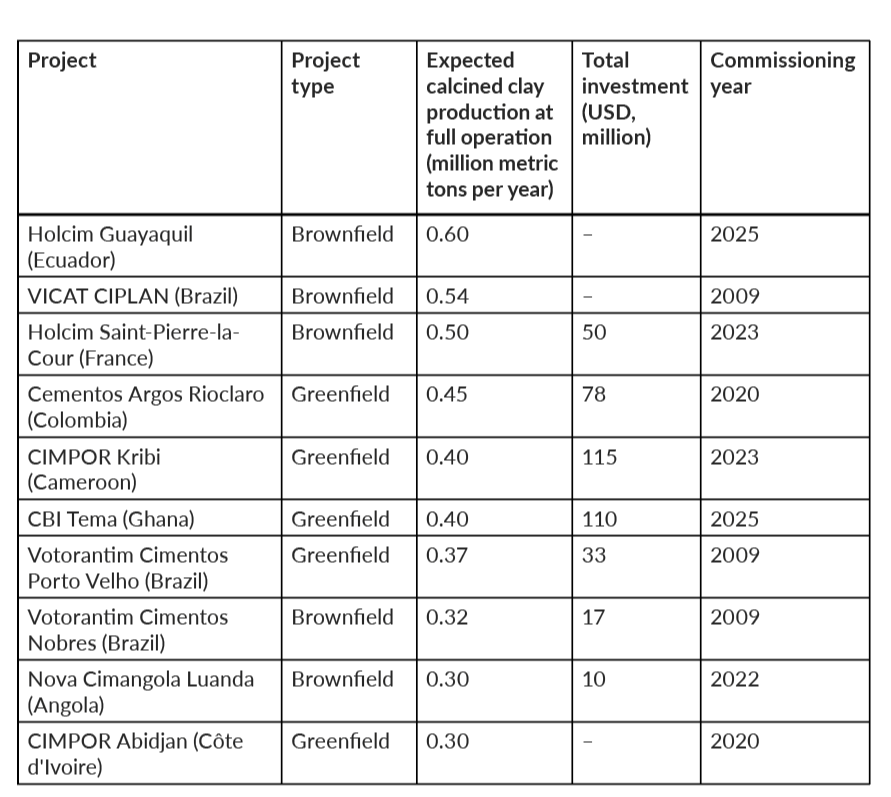
muchhigher quantities in the humid tropics, making it highly relevant for countries in Africa, Latin America and Asia where the majority of future construction is projected to take place. - African and Latin American countries, in particular Ghana with two of the world’s largest production facilities, are emerging as frontrunners in the commercial production of cement with calcined clay.
- Calcined clay cement has proven its viability at scale. The majority (over 72%) of all projects tracked have been announced at commercial scale, not as pilot or demonstration projects. And over two-thirds (70%) of these commercial-scale projects are already operational.
- Based on operational and announced projects, calcined clay could unlock 26 million metric tons per year of lower carbon cement capacity but even with an optimistic 35% blend, this represents less than 1% of the 4,000 million metric tons of cement produced globally today.
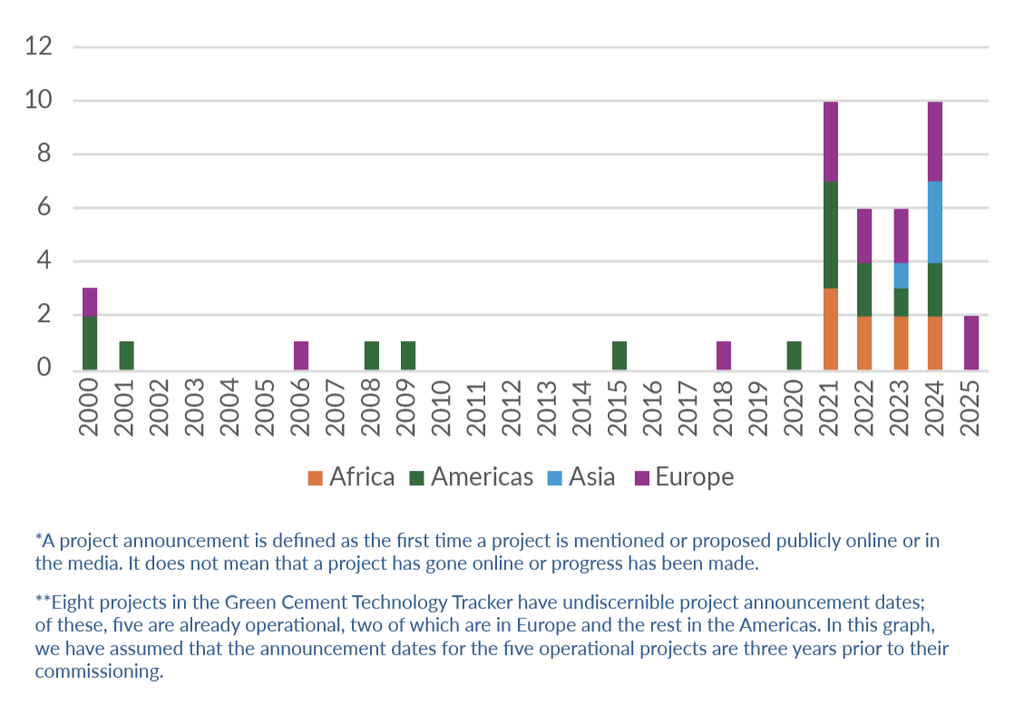
Commercial scale calcined clay kiln project announcements* by year and continent**
State of progress
Very few new projects were announced in 2025, but the LeadIT analysis identifies at least five more projects to be commissioned during 2026. Four of these are in Africa, and one in Europe. A second European plant in this 2026 pipeline was successfully commissioned in September 2026. LeadIT members, Holcim launched a new calcined clay production line at its Čížkovice plant, the first of its kind in the Czech Republic.
Taking into account a longer-term pipeline, our analysis shows 14 active projects spread across Africa, Europe and the Americas. If all these projects come online as projected, this will boost production of lower-carbon cement – replacing some clinker with calcined can deliver emissions reductions of up to 40% compared to OPC. However, this will still represent just a tiny percentage (less than 1%) of the current global cement production capacity, which stands at 4000 million tons per year.
Our analysis underlines the need for faster implementation. Delivering significant emissions reductions in the cement industry will require an accelerated and more extensive scaling not just of calcined clay projects but also other low-carbon technologies in the future.

Perez Yeptho
Analyst,LeadIT
Calcined clay for emissions reduction
Ordinary Portland Cement (OPC) relies on clinker, produced by heating a mixture containing limestone and clay to around 1500°C. This process is highly emissions-intensive: burning fuel to reach these temperatures generates CO₂, while the chemical transformation of limestone itself releases further CO₂.
Calcining suitable clays at much lower temperatures and using them to replace a share of clinker can significantly reduce these emissions. Limestone calcined clay cement (LC3) is currently the most prevalent cement produced in this way, based on a blend of limestone (15%) and calcined clay (30%). This process can reduce emissions of cement by up to 40% and can be economically competitive with OPC depending on local conditions. Further emissions reductions in calcined clay can be achieved by the development of electrified calcination technologies. Examples include electric arc calciner technology or electrified linear calcination conveyors, which replace fossil fuels with electrified alternatives that, when paired with clean, renewable electricity, can reduce emissions even further.
Top 10 operational calcined clay production plants in the Green Cement Technology Tracker by annual calcined clay production volume