




The commissioning of the world’s first carbon capture and storage facility at a cement factory in Norway in the summer of 2025 demonstrated that the technology is a viable decarbonization pathway at scale. Cement is the world’s most widely used material after water, but it is also responsible for around 8% of global CO₂ emissions, making emissions reductions in the sector vital to achieving global climate goals. New data from the LeadIT Green Cement Technology Tracker shows that although first-of-a-kind carbon capture projects are now online, less than 2% of total global emissions from the cement industry are projected to be captured by 2035.
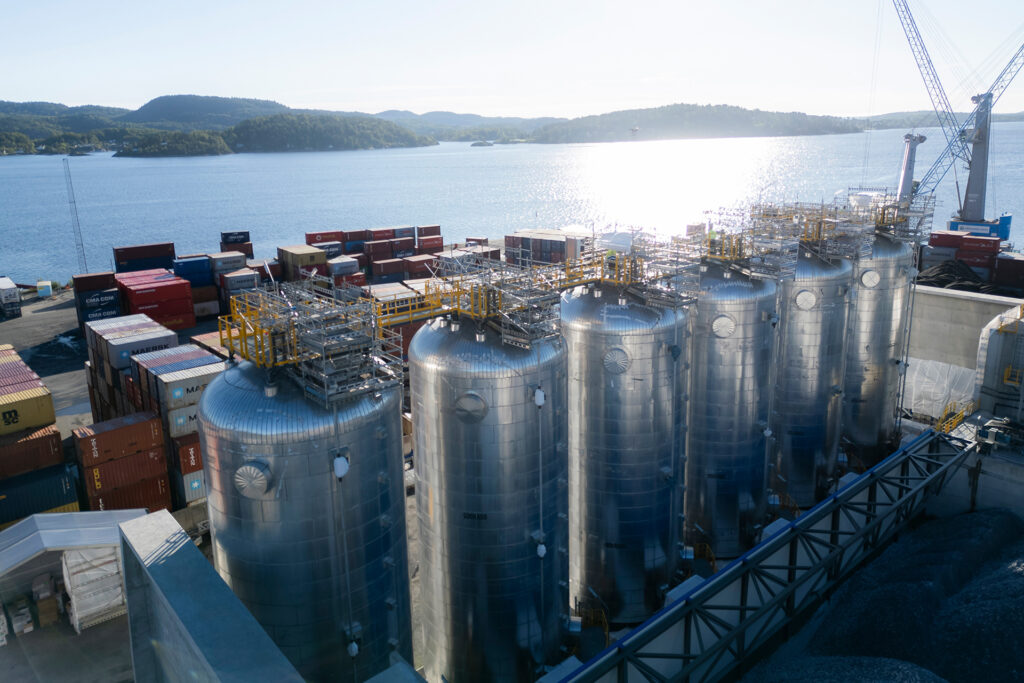
The world’s first commercial project is an important breakthrough, but scaling the impact of this technology could be limited without significant support and infrastructure. When the projects currently planned become operational, the total volume of captured emissions would represent less than 2% of the sector’s overall footprint by 2035, highlighting a critical gap between ambition and impact.

Perez Yeptho
Analyst, LeadIT
Key findings of the analysis include:
Policy and infrastructure are decisive success factors. Government support is a vital feature of early full-scale carbon capture projects in the cement sector. The Brevik facility in Norway, for example, benefited from a funding model covering more than 80% of capital costs. Conversely, projects in Sweden and California have been delayed, paused or cancelled after failing to secure, or losing, government finance. This suggests that public finance and risk-sharing are currently vital in bringing full-scale cement CCS projects to completion.
Access to CO₂ transport and storage infrastructure is another critical enabling factor. Every project currently advancing relies on shared networks such as those in the North Sea or the Adriatic Sea. Without these systems, projects cannot move forward regardless of technological readiness.
Global momentum shifts to Asia. After years of steady growth, new cement carbon capture project announcements slowed sharply in 2025, with just 12 projects announced globally. Only three of these were commercial scale, down from a peak of 15 in 2024. Asia led in total announcements for the first time, overtaking Europe, although all large-scale projects were still in Europe.
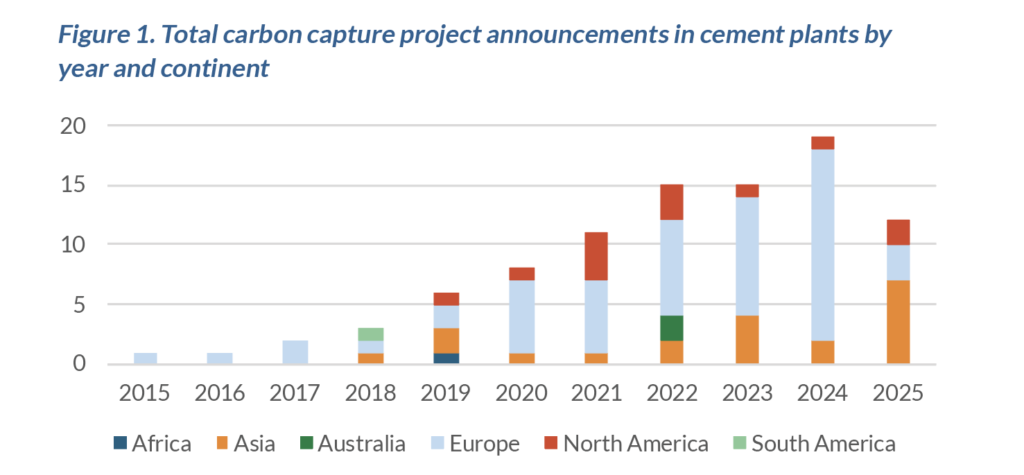
Despite this trend, the slowdown should not be seen as proof of slowing momentum. The sector is in an early commercialization stage, where the successful delivery of first-of-a-kind large-scale projects is more significant for building confidence and unlocking future investments, rather than the number of announcements.

Aaron Maitais
Policy Lead, LeadIT
Future prospects for carbon capture and storage
Looking further ahead, the number of commercial-scale CCUS plants in operation is expected to grow from one in 2025 to 38 by 2035. Notably, many of these future projects are planned at considerably larger capture rates than Brevik, meaning the sector should expect a succession of headline-grabbing milestones as increasingly ambitious facilities come online. The cumulative cement manufacturing capacity linked to operational CCS plants is projected to reach approximately 58 Mt per year by 2035, a nearly 60-fold increase from today, yet less than 2% of total global cement production. The cement sector has a growing portfolio of viable low-carbon solutions, including clinker substitution, alternative clinker chemistries, and electrified kilns, but no single technology has yet emerged as a complete substitute for conventional cement on a global scale. Consequently, carbon capture is widely recognized as a major lever for cutting the sector’s emissions. However, delivering carbon capture and storage projects at the scale needed to significantly reduce emissions remains the biggest challenge for this technology.