LeadIT Members adopt a joint statement following high-level Summit at COP27.

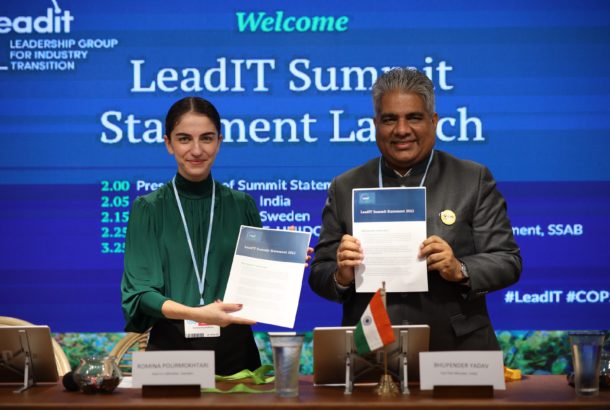
EGYPT 15 November – Today, LeadIT members adopted a joint statement at the LeadIT Summit at COP27. The statement was launched at the India Pavilion at COP27 with special remarks by Bhupender Yadav, Minister of Labour and Employment, Environment, Forest and Climate Change, India, and Romina Pourmokhtari, Minister for Climate and the Environment, Sweden.

Read the Statement

LeadIT Summit Statement 2022
microsoftteams image 10

Romina Pourmokhtari, Minister for the Environment, Sweden, Bhupender Yadav, Minister of Labour and Employment, Environment, Forest and Climate Change, India

The statement highlights 2030 as a critical milestone on the path to net-zero emissions. It notes that LeadIT members will promote partnerships along value chains to strengthen the business case for low-carbon products and their supply.

The statement calls on LeadIT member countries – India, Japan and Sweden – to cooperate on industry transition as they preside over the G20, G7, and the Council of the European Union in 2023.

The group urges industrialized economies to apply all levers available to foster the industry transition in developing countries and emerging economies. International cooperation to mobilize and guide the flow of private capital is a vital enabler for industry transition in developing countries and emerging economies. To facilitate the deployment of climate finance and private capital to specific industry transition projects, developing countries and emerging economies commit to formulating roadmaps for heavy industry sectors.

ministers

Left to right: Felipe Sanchez (LeadIT), Rob Watt (LeadIT), Helen Ågren (Ministry of the Environment, Sweden), Romina Pourmokhtari (Minister of the Environment, Sweden), Bhupender Yadav (Minister of Labour and Employment, Environment, Forest and Climate Change, India), Rania Al-Mashat (Minister of International Cooperation of Government of Egypt)

LeadIT Members collectively agree to:  

  • Promote value chain partnerships and material circularity. 
  • Invest and cooperate on the planning and implementation of infrastructure to support energy and industry transitions. 
  • Give multilateral development banks and multilateral climate funds mandates to de-risk investments in the transition of heavy industries in emerging and developing countries. 
  • Emerging economies and developing countries to formulate roadmaps for heavy industry sectors that include regulatory frameworks, incentives, and long-term strategies, to facilitate transition finance and attract private investments.

The LeadIT Secretariat commits to: 

  • Provide technical assistance to existing and new members to develop roadmaps for heavy industry sectors; 
  • Assess international assistance offered to heavy industry in developing countries and emerging economies; 
  • Support the sharing of best practices and know-how on overcoming obstacles to industry transition; and 
  • Work with youth organisations to raise the profile of the skills and gender gaps.  

Insights.

You may also be interested in these LeadIT analyses.

View all

26 Nov 2025

COP 30 Technology, Transition, and Trust – the role of trade and international cooperation for just & equitable industrial transition

This panel event during COP30 in Belém highlighted both some of the opportunities and the complexities involved in using trade to accelerate industrial decarbonization.

Climate Politics

co-development

Emerging and Developing Economies

EU

Partnerships

Read full article

27 Oct 2025

Transition, Trade and Trust – Industry Decarbonisation in Uncertain Times

Written by Per Andersson

In Geneva on 23 and 24 October 2025, the Forum on Trade, Environment and the SDGs (TESS) organised its first annual conference "Trade Cooperation Pathways for Climate Action, Resilience and Justice". The event gathered leading experts from the worlds of trade and climate policymaking, including LeadIT's Head of Secretariat, Per Andersson.

Climate Politics

co-development

Emerging and Developing Economies

EU

Finance

G20

Leadership

Policy

Read full article

23 Oct 2025

Pathways to inclusive green industrial policy: building shared opportunities across economies

Written by Aaron Maltais, Timothy Suljada

Major economies are implementing green industrial policies to speed up decarbonization and transform production. However, many approaches prioritize national competitiveness and security, and risk marginalizing developing countries. The article proposes four categories of measures to align industrial strategies with global fairness, shared climate objectives, and the Paris Agreement’s goals.

Climate Politics

Emerging and Developing Economies

EU

Finance

Industry Transition Partnership

Read full article

3 Oct 2025

From GERD to Green Growth: Ethiopia’s Cement Industry at a Crossroads

Written by Arati Davis, Jane Birch

Built with more than 10 million tonnes of cement, the Great Ethiopian Renaissance Dam (GERD) stands as a powerful symbol of Ethiopia’s economic transformation. The shift from a largely agriculture-based economy is fueling the growth of industry, particularly cement production. New homes, schools, and hospitals are essential, but they also bring the risk of rising emissions.

Cement

Climate Politics

Emerging and Developing Economies

Ethiopia

Leadership

Nationally Determined Contributions (NDCs)

Partnerships

Read full article

24 Apr 2025

Technology Transfer – a WTO thematic session

Written by Jane Birch

On April 1st, 2025, the World Trade Organization (WTO) Committee on Trade and Environment (CTE) held its first thematic session dedicated to technology transfer featuring a range of speakers, including Per Andersson, Head of Secretariat at LeadIT.

Climate Politics

co-development

Finance

Partnerships

technology

Read full article

9 Apr 2025

Sustainable Industrial Transitions: Building global partnerships for inclusive green competitiveness

Written by Aaron Maltais, Timothy Suljada

A high level roundtable focussing on the global implications of the EU’s Clean Industrial Deal which explored opportunities to align green industrial policy with shared climate objectives, while balancing national competitiveness concerns.

Clean Industrial Deal

Climate Politics

EU

Finance

Policy

Read full article