


EGYPT – At the LeadIT Summit held during COP27, members agreed to promote value chain partnerships and material circularity, deliver on infrastructure pledges, and support industry transition in developing countries.
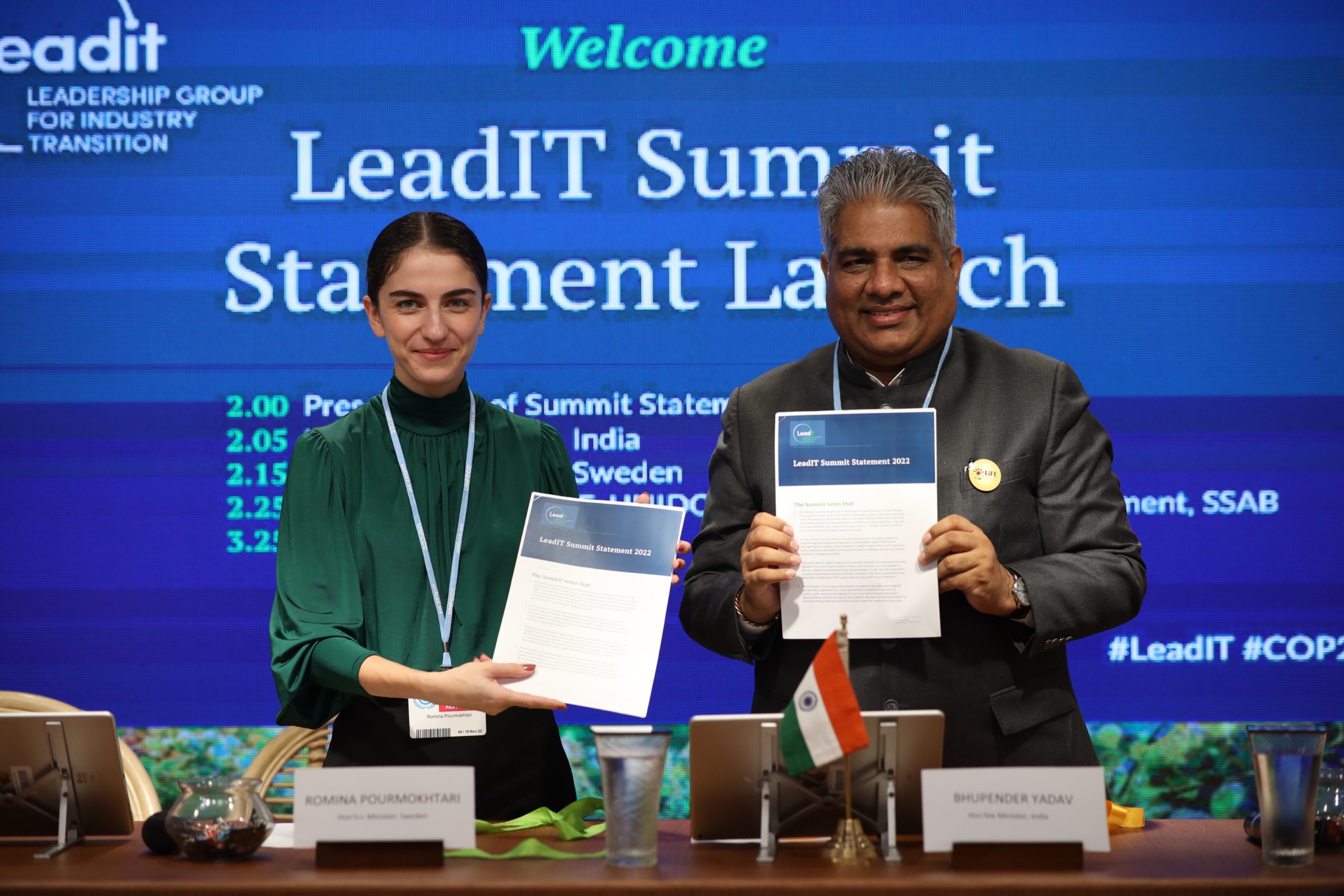
The Summit was opened by LeadIT’s founders India and Sweden, joined by Egypt. LeadIT’s contribution to industry transition was highlighted by all three Ministers, with Sweden’s Minister for Climate and the Environment Romina Pourmokhtari noting that as one of the first public-private initiatives, LeadIT has “in its three years spurred action, set the global agenda for the decarbonization of hard-to-abate sectors, and stimulated new initiatives”.
The value of LeadIT as a common forum for economically diverse countries, ambitious in their climate goals, was also emphasised. Bhupender Yadav, Minister of Labour and Employment, Environment, Forest and Climate Change, India stressed that “co-development is the only way to reach the targets the world has set for itself”. Rania Al-Mashat, Minister for International Cooperation, Egypt said the LeadIT Summit was a great opportunity “to reflect the voices of countries in different stages of development and path to net zero”.
Strengthening the global business case for green industrial products
In the Summit Statement, LeadIT Members agreed to promote partnerships along value chains to strengthen the business case for low-carbon products and their supply. Calls for a whole value chain approach came from both companies and countries. Rob Jetten, Minister for Climate and Energy, The Netherlands, urged for policies that stimulate decarbonisation across all global value chains. Annika Ramsköld, Vice President at Vattenfall called on companies to do their part not only in bringing clean products to market themselves but also in requiring clean products in their value chains.
All members agreed that international cooperation is critical to align on policy measures such as infrastructure investments, carbon pricing, carbon leakage, trade, and standards to create a level playing field: “We have limited time and financial means; we should be as focused as possible when it comes to supporting industry transition pathways. We need public-private forums such as LeadIT to align on actions. Time is up for waiting for each other, we need to move together”, said Leonore Gewessler, Minister of Climate Action, Environment, Energy, Mobility, Innovation and Technology, Austria.
Both countries and companies called for a global standard for green industrial products. Ministers Jetten, Netherlands and Gewessler, Austria, Martin Pei, CTO at SSAB, and Ryo Minami, Deputy Commissioner for International Policy on Carbon Neutrality, Japan, noted that standards are needed to enable trade and fair competition, create demand and guide investments.
LeadIT could play a key role in setting standards, said Varun Sivaram, Managing Director and Senior Advisor, Clean Energy & Innovation, US Special Presidential Envoy for Climate, U.S; having LeadIT countries and companies sign on and adopt international standards for green industrial products would send a strong demand signal.
Enabling developing countries to join the race to net zero
The group urged industrialized economies to apply all levers available to foster the industry transition in developing countries. “Hard-to-abate sector transition in developing countries can only be successful with the right implementation support, such as technology transfer and financing”, stressed Minister Yadav in his opening speech.
The need to improve access to finance and strengthen North-South discussions to share best practices was highlighted by Egypt: “Multilateral development banks should be increasing funding to attract more investment into the sectors that are in need in developing countries.”
UK’s Minister for Climate, Graham Stuart, called for a diversified approach to support developing countries in creating solutions to their unique transition challenges, with the UK itself having recently invested £6.5mln to support clean energy innovation in developing countries. Hakan Gurdal, Heidelberg CEO for Africa & East Med, encouraged more regulation and incentives in developing countries to maintain competitiveness.
Launch of Summit Statement at India Pavilion
The Summit Statement was launched after the summit at the India Pavilion with special remarks by Minister, Shri. Bhupender Yadav India, and Minister Romina Pourmokhtari, Sweden. A panel with key stakeholders including the US, South Africa, Dalmia Cement, SSAB, the Climate Investment Fund, and UNIDO discussed how to catalyze action for industry transition in 2023.
The panel concluded that standards for green industrial products, a global carbon price, demand creation, and support to developing countries are critical to accelerating industry transition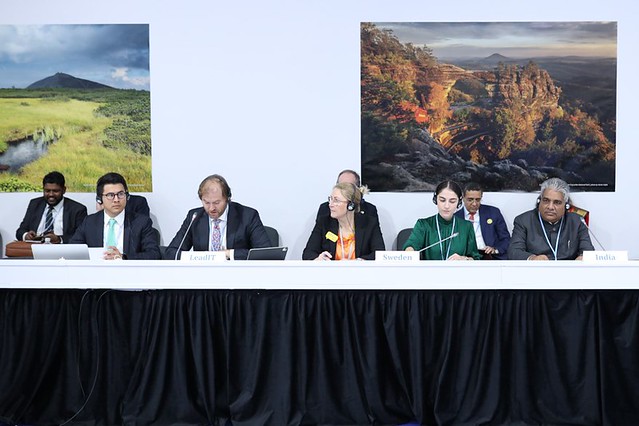
LeadIT Members collectively agree to:
- Promote value chain partnerships and material circularity.
- Invest and cooperate on the planning and implementation of infrastructure to support energy and industry transitions.
- Give multilateral development banks and multilateral climate funds mandates to de-risk investments in the transition of heavy industries in emerging and developing countries.
- Emerging economies and developing countries to formulate roadmaps for heavy industry sectors that include regulatory frameworks, incentives, and long-term strategies, to facilitate transition finance and attract private investments.
The LeadIT Secretariat commits to:
- Provide technical assistance to existing and new members to develop roadmaps for heavy industry sectors;
- Assess international assistance offered to heavy industry in developing countries and emerging economies;
- Support the sharing of best practices and know-how on overcoming obstacles to industry transition; and
- Work with youth organisations to raise the profile of the skills and gender gaps.