



Ethiopia’s shift from a largely agriculture-based economy is fueling the growth of industry, particularly cement production, which sits at the heart of the country’s development story. New homes, schools, and hospitals are essential, but they also bring the risk of rising emissions. Cement is among the most carbon-intensive materials, contributing around 7% of global CO₂ emissions.
As one of the first African countries to join LeadIT, Ethiopia has since 2021 demonstrated a strong commitment to the goals of the Paris Agreement. Determined to meet the twin challenges of building a new economy while delivering on climate targets, the Ethiopian government turned to LeadIT to explore models of best practice. From the outset, Ethiopia emphasized collaboration: industry and government working together to identify scalable technologies and solutions.
Lessons from India
Ethiopia had already mapped out some low-carbon pathways, including replacing coal with biomass in cement kilns, developing LC3 cement using calcined clay to replace part of the limestone responsible for process emissions, testing alternative binders, and implementing energy efficiency measures. What was missing was a clearer understanding of how these pathways were being applied in another emerging economy. India, with its fast-growing cement sector and track record of innovation, soon became the natural focus.
In April 2025, a delegation of Ethiopian government and industry representatives traveled with LeadIT to India. Over four days, they investigated low-carbon solutions and explored how knowledge sharing and capacity building could address one of the toughest decarbonization challenges.
At the ACC/Adani Cement plant in Wadi, delegates saw first-hand how waste-derived alternative fuels (AF) and raw materials (AFR) were being integrated, alongside a Waste Heat Recovery System to reduce reliance on fossil fuels. AF inputs used here include pharma waste and old tyres. Discussions at the site emphasized the role of enabling policies in supporting the factory’s transition
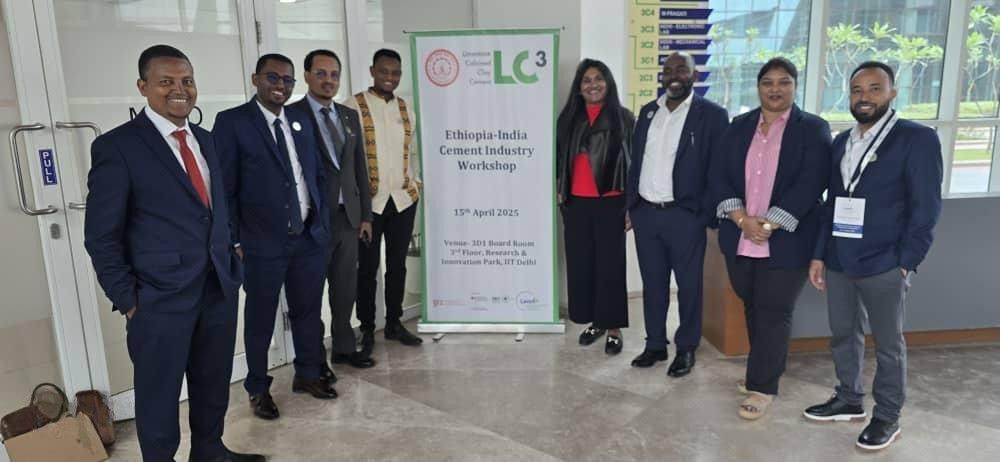
A workshop at the Indian Institute of Technology in Delhi brought the delegation together with Professor Shashank Bishnoi, a world-renowned cement chemist and India’s lead on Limestone Calcined Clay Cement (LC3). As the architect of India’s LC3 standards, Dr. Bishnoi shared insights into scaling new materials and overcoming technical barriers.
The visit ended with a reception hosted at the Ethiopian Embassy in India, whre the delegation met the Ethiopian Ambassador Fesseha Shawel Gebre and Swedish Ambassador Jan Thesleff. Discussions round the table considered on how Common But Differentiated Responsibilities (CBDR) intersect with equitable and just transitions. The EU’s Carbon Border Adjustment Mechanism (CBAM) and broader carbon pricing policies also featured in the exchange.
![img 1434[50]](https://www.industrytransition.org/content/uploads/2025/09/img-143450-scaled.jpg)
A commitment to low-carbon cement pathways
In September 2025, Addis Ababa hosted the second Africa Climate Summit. With a focus on amplifying African voices in global climate action and championing homegrown adaptation and mitigation solutions, it provided the ideal venue for further dialogue on cement decarbonization.
During the Summit, Ethiopia launched its third-generation Nationally Determined Contribution (NDC 3.0). NDCs are countries’ national climate action plans under the Paris Agreement and this update from Ethiopia lays out detailed sectoral pathways and milestones, including for cement. But it also makes clear that achieving these targets will require significant external finance, technology transfer, and capacity-building support.
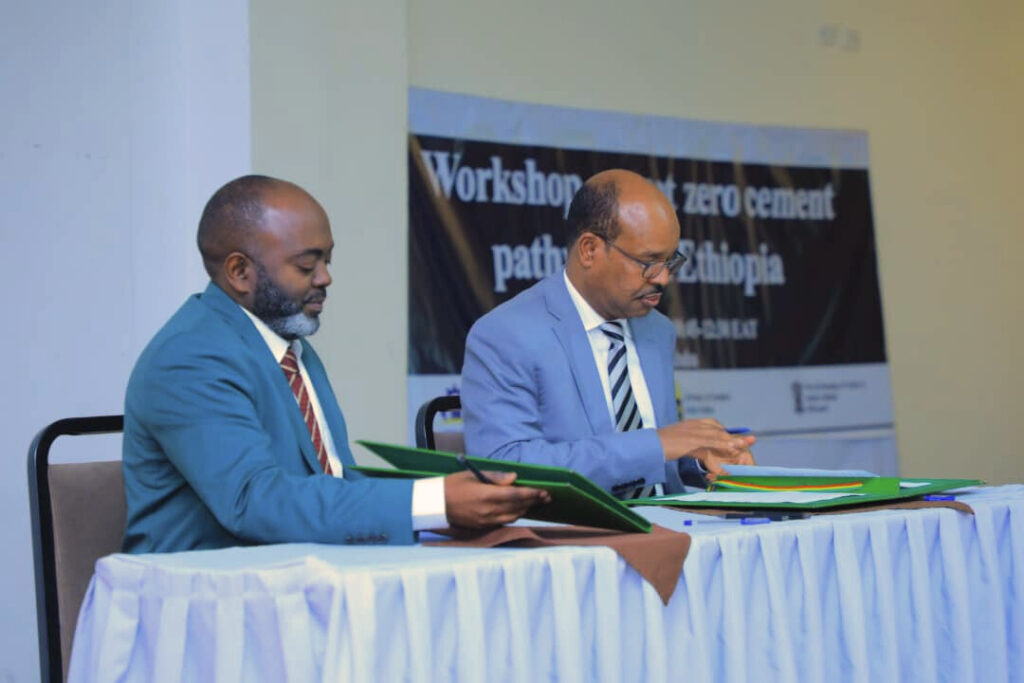
LeadIT, invited by Ethiopia’s Ministry of Planning and Development and Ministry of Industry, convened two events at the Summit to explore how public–private partnerships could accelerate progress. A tangible outcome was the signing of a joint statement between the Ministry of Industry and the Ethiopian Cement Producers Association. This agreement committed to a comprehensive technical and economic assessment of low-carbon cement technologies and the enabling policies needed to deploy them.
With thanks to Nubia Media & Communications. Library footage from InOldNews.
Next steps
Ethiopia’s journey shows how collaboration, knowledge exchange, and political will can lay the foundations for industrial transformation. The work has only just begun, but as Ethiopia looks ahead, it has the potential not only to reshape its own cement sector but also to become a model that inspires other African countries on the road to green industrialization. As part of that ambition, Ethiopia hopes to host COP32 in 2027, having formally launched a bid to stage the climate conference in Addis Ababa.